

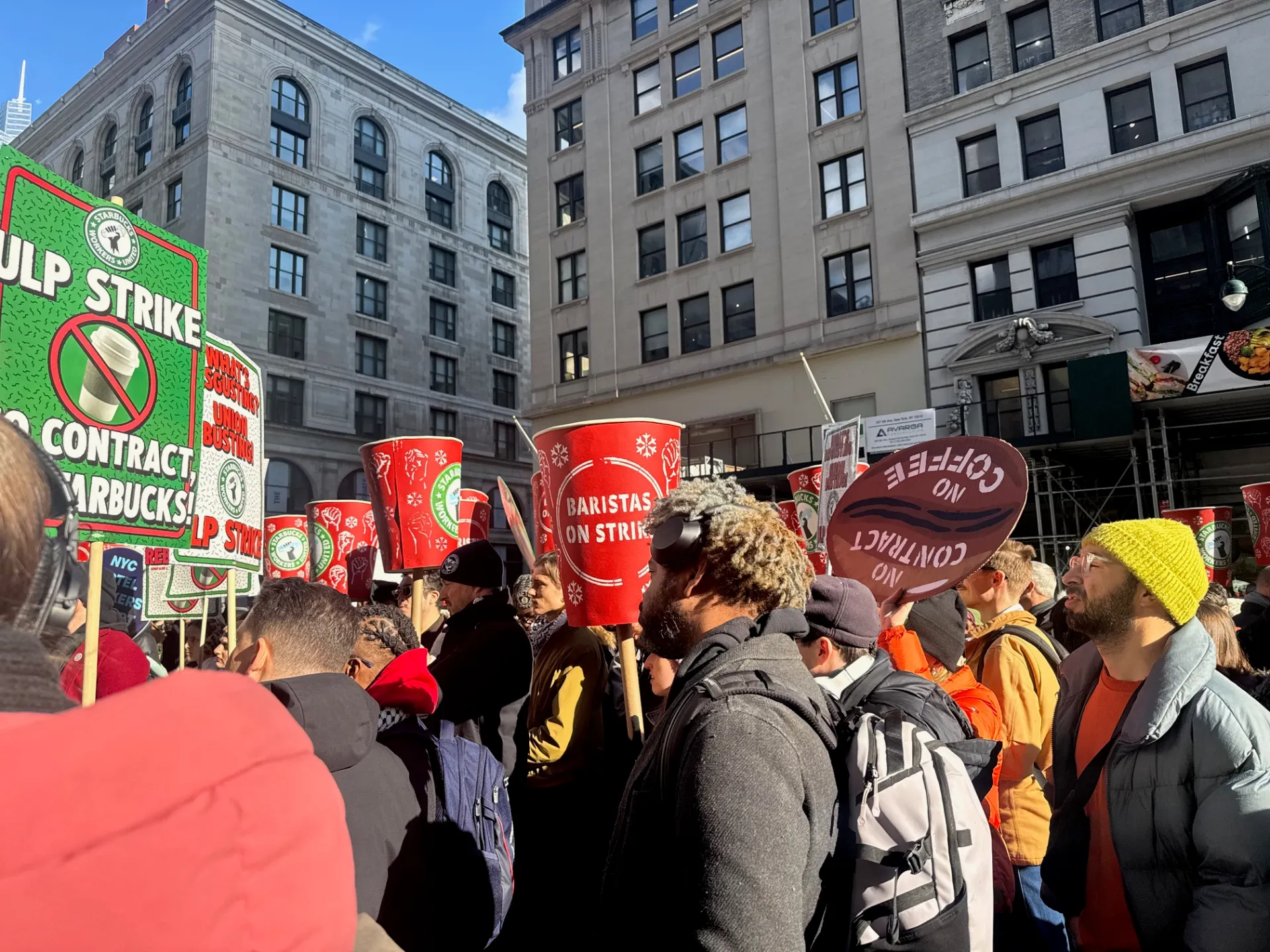
New York City, United States – An emotional crowd of a few hundred people stood on heavily trafficked Fifth Avenue in New York City with picket signs calling on coffee giant Starbucks to negotiate a contract with its union.
Picketers stood on the sidewalk holding signs reading “No contracts, no coffee” and “Baristas on strike”, blocking the front doors of the Empire State Building, the most iconic landmark in the United States and which houses an office of the company along with one of its high-end signature stores called Starbucks Reserve.
Recommended Stories
4 item listend of list
Many protesters were arrested. Two men identifying themselves as “T-Bone” and “Alon” spoke to Al Jazeera about why they were protesting.
“Stop blocking contracts, negotiate with workers and sign contracts for fair wages,” Elon, one of the detained baristas, told Al Jazeera while being loaded onto an NYPD bus.
Starbucks Workers United told Al Jazeera that a total of 12 people were arrested, but the NYPD did not respond to Al Jazeera’s request to confirm the figures.
Starbucks representatives said that according to their “rough estimate”, only 25 people in the crowd were actually team members.
Representatives of Starbucks Workers United protested and told Al Jazeera that more than 100 baristas were present.
This is the third consecutive week of open-ended strikes, which began on Nov. 13 as the union demanded Starbucks give them a contract.
war of words
These tensions are nothing new for the company, which operates 18,300 stores in the US and Canada. They come amid the coffeeshop chain’s long history of disputes with its employees. In December 2024, when negotiations for a contract that had begun in April stalled, workers began a strike.
At the time, the union rejected a proposal that guaranteed a 2 percent raise but did not include any improvements to health care packages, which workers said was inadequate. Starbucks hasn’t budged.
“We are focused on continuing to offer the best jobs in retail, including an average salary of more than $30 an hour for hourly partners and benefits. The facts speak for themselves: partner engagement is up, turnover is about half the industry average, and we receive more than 1 million job applications per year,” Starbucks spokesperson Jackie Anderson told Al Jazeera.
Starbucks Workers United says the starting wage, not including tips, is $15.25 an hour in 33 states. This is what Al Jazeera found on Starbucks’ job board: A barista position in Elko, Nevada starts at $15.25, a supervisor role in Kansas starts at $19.37 per hour, a barista role in Brooklyn, New York is open to a starting salary of $17.25 and a shift supervisor role starts at $22.25 per hour.
The union said many baristas get less than 20 hours per week, which is below the cut-off for benefits; Al Jazeera was unable to independently verify those claims.
Starbucks said the union is seeking a 65 percent pay increase in the immediate future and 77 percent over the next three years, and higher pay for other elements of their job, including weekend hours, early or late hours, sorting inventory and working on promotion days such as the store’s Red Cup Day, which typically brings heavy traffic.
Starbucks Workers United has pushed back, saying it is a misinterpretation of their requests and combines multiple proposals into one.
“This allegation is not true. We presented a set of economic proposals as negotiated options and ultimately achieved higher wages and benefits. Starbucks simply said ‘no’ to all of them, and then dishonestly combined all the options as if they were a unifying demand,” Michelle Eisen, spokeswoman for Starbucks Workers United, told Al Jazeera.
“It would be like going to Starbucks, adding up the entire menu, and saying it costs $1,000 to order a drink at Starbucks.”
political pressure
Starbucks is also facing increasing pressure in New York City, where the chain has 300 stores. The outgoing mayor, Eric Adams, and the incoming, Zohran Mamdani, are both pressuring the company to meet the union’s demands.
This week, the current Adams administration reached a $38.9 million settlement with the coffeeshop chain for violations of the city’s Fair Workweek law, which requires employers to provide predictable schedules, advance notice before hiring new employees, and give existing employees the opportunity to work more hours. The city’s Department of Consumer and Worker Protection (DCWP) said the company has committed more than five lakh violations of the law since 2021.
The agreement covers people who worked at one of 300 locations in New York City between July 4, 2021, and July 7, 2024.
Also this week, Mamdani and Vermont Senator Bernie Sanders joined striking workers outside a Starbucks location in Brooklyn, New York.
While Mamdani responded to Al Jazeera’s questions at a press conference on Tuesday, his press team did not respond to requests for comment following the arrest of members of the union with whom he had marched only two days earlier.
Sanders – who questioned then-CEO Howard Schultz over union-busting allegations in March 2023 – told Al Jazeera that the momentum is now in workers’ favor.
“I will tell you what’s different is that over the years, four years have come and gone, and hundreds of stores have voted to join unions, 12,000 employees have voted to join unions. And yet Starbucks has refused to sit down and negotiate a fair contract,” Sanders told Al Jazeera.
It is not clear what the next step will be. At the federal level, under the administration of US President Donald Trump, the National Labor Relations Board – the federal agency where workers bring labor rights complaints – has been downsized.
Since Trump took office, the agency has lacked a quorum, meaning there are not enough members to make important decisions related to allegations of unfair labor practices. Earlier this year, the Trump administration fired board member Gwynne Wilcox, and general counsel Jennifer Abruzzo, two Biden-era appointees who had taken pro-labor stances.
chronic stress
A nationwide movement – a wave of unionization that has called for better wages – has been going on for several years, starting after a store in Buffalo, New York voted to unionize in 2021.
Allegations of union-busting practices under then-CEO Schultz included surveillance among workers and what were called “captive audience” meetings in which workers were required to listen to anti-union messages from the company.
In 2024, the NLRB ruled that Schultz had threatened employees at a 2022 town hall in which he said, “If you’re not happy at Starbucks, you can go work for another company.”
“There is a weariness among New Yorkers about the sheer contradiction between these workers, who can’t afford to live in this city, and the CEOs who are making $96 million a year on the strength of the labor of those same workers,” Mamdani said.
Mamdani was referring to Brian Niccol, who took over from Schultz as CEO in September 2024, whose compensation package was worth about $96m – or 6,666 times the average employee salary. According to the AFL-CIO’s Executive PayWatch Tracker, this represents the largest CEO-to-employee pay gap among the S&P 500.
With sales declining, Nicol was brought in with hopes that he would turn the company around after a short tenure by Lakshman Narasimhan, who was ousted by the board amid increasing pressure from activist investors and slow sales.
Starbucks Workers United said the former CEO was at the negotiating table.
“It was during his tenure that bargaining began in a real way [Narasimhan] Leadership,” Eisen said.
a new ceo
According to Eisen, Nichol’s appointment was a step backward.
“We had nine months of really good bargaining through 2024, which stopped when this current CEO stepped into that role,” said Eisen, whose Buffalo location became the first store to vote to unionize.
Nicole has struggled to deal with falling sales. Global same-store sales increased 1 percent in the fourth quarter of 2025 compared to the previous quarter, boosted by international markets. Same-store sales remained stable in North America.
In September, the Seattle-based coffee shop chain announced the closure of 1 percent of its U.S. stores. Although this has no impact on store employees, 900 corporate employees lost their jobs as part of a $1bn restructuring plan.
Niccol comes from Chipotle, where he faced multiple union-busting allegations and settlements during his more than six years leading the company. In 2023, the company closed its first unionized store in Augusta, Maine, and later agreed to pay $240,000 to store employees as part of a settlement.
Chipotle also faced a similar penalty from New York City, much like this week’s settlement with Starbucks. In 2022, the company agreed to pay $20 million to settle charges that it violated city labor laws, including failure to provide predictable schedules and paid sick leave. That agreement covered 13,000 workers.
Under Nicholl, the chain was also accused of violating child labor laws nationwide and paid settlements. In 2022, the company settled with the state of New Jersey for $7.75 million after a state agency found more than 30,000 allegations of child labor violations. In Massachusetts, the company paid nearly $2 million to settle 13,000 allegations of child labor law violations.
Workers hope that amid the agreement this week, new pressure from lawmakers and the large number of picketers will be enough to move contract talks forward.
“I think this company recognizes that there are some serious systemic issues within it. I think they recognize that the solutions people are in the café every day and we’re just waiting for them to start negotiating so we can finalize that contract,” Eisen said.
And a company spokesman suggested it was also amid a crackdown on strikers on the picket line.
Anderson said, “We have been very clear that we are ready to talk when the union is ready to return to negotiations. Instead, they are focused on organizing and promoting protests in New York City, where they represent only 200 of the 4,500 participants in NYC.”
